Let's Talk About Agents

The study of minds is at a stage not unlike the study of life was in the early 1800s. Fractured, with many ideas and theories, with different disciplines all having their own perspectives, but plausibly one remarkable idea away from explaining the entire thing.
For living things, this was Darwin's evolution by natural selection. This simple idea unified all living things, from bacteria to oak trees to people, and provided a foundation for everything that we subsequently have learned about how life works.
In the study of mind, we don't have a Darwin yet. We are still in the fractured phase. Neuroscientists, physicists, computer scientists, roboticists, psychologists, and philosophers, all have their own ideas about it. There is overlap and agreement about some things. But still, many reasonable ideas about minds remain at odds with each other.
The situation is complicated even more because we all have one. We can't help but have personal opinions about what it is, what it is for, and how it works. It contains a part of everything every living being that has ever lived is.
Darwin's work was controversial because it implied people were just one more kind of living thing. Scientific studies of minds inherit a worse kind of problem. Being the product of evolution is one thing, but it isn't personal. All people are in the same camp, for better or for worse. A science of what makes you you may produce answers that dramatically conflict with your own core views of who and what you are, whether or not you have a purpose, what happens to you when you die, whether you are fundamentally different from an intelligent machine, or what a life well lived is. This makes this type of science intensely personal for everyone. And very difficult to do in the objective way good science needs to be done.
I am going to describe an idea that could be a Darwin-like unifying principle for understanding minds. It is a foundational principle in a field called reinforcement learning, or RL, whose historical roots include the study of both living creatures and the optimal control of machines. In its modern incarnation RL is used to build immensely powerful software-based learning systems, such as AlphaGo. I will do my best to tell you about this amazing and incredible idea with as little technical jargon as possible.
First let me show you a picture. This is Figure 3.1 from the foundational RL textbook, Sutton and Barto's Introduction to Reinforcement Learning, 2nd edition.
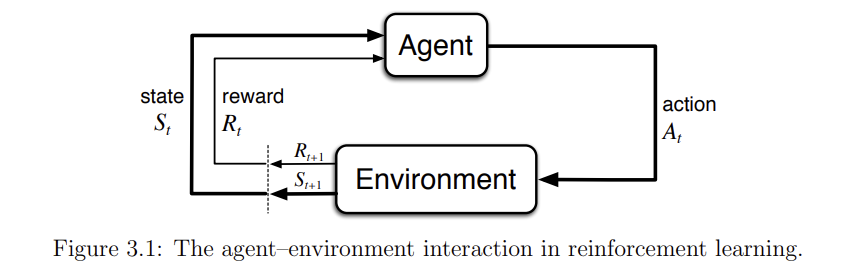
It is deceptively simple looking. I think of it on the same level as, say, Einstein's field equations $R _{\mu\nu} - \frac{1}{2} g _{\mu\nu} R + \Lambda g _{\mu\nu} = \frac{8\pi G}{c ^4} T _{\mu\nu}$, or the Schrodinger equation $i \hbar \frac {\partial}{\partial t} \Psi (\mathbf {r}, t) = \hat {H} \Psi (\mathbf {r}, t)$. All of these are compressed representations of a set of deep, non-trivial, and non-obvious fundamental ideas.
Let's start unpacking this picture.
We separated the universe into two parts, which we called agent and environment.
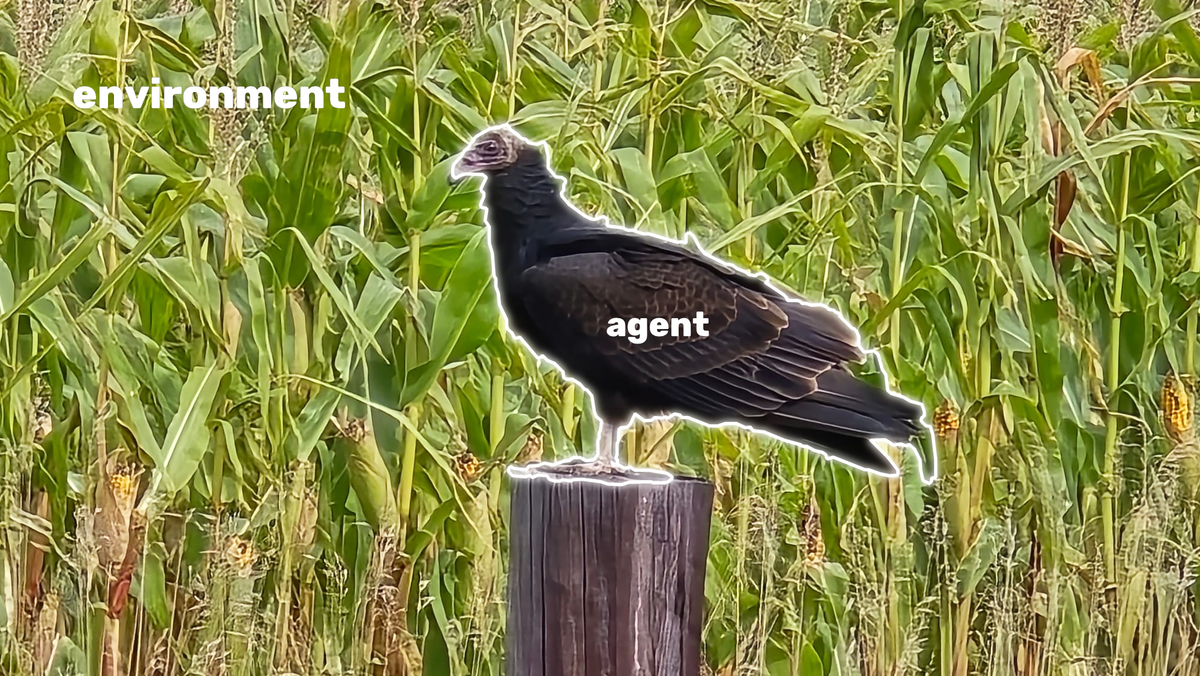
If we think about embodied intelligences, like you, a robot, or the turkey vulture in the header image, it is tempting to draw an outline around the entity and think of all the stuff inside as the agent, and everything outside the environment. And we could do so.
But an important part of understanding the RL diagram is that the world does what it does, regardless of where we choose to draw the border. If we draw a boundary between what we consider agent and what we consider environment, the behavior of the world doesn't change. Where we draw the boundary is just a choice, like the choice of a basis in physics. We can always separate any universe into two parts, and call one 'the agent', and the other 'the environment'. We can even switch the labels, swapping which is the environment and which is the agent.
Where we choose to draw the boundary between the two, and which we call the agent, is simply a matter of convenience for whatever we are trying to achieve. It is not a fundamental property of the world.
The environment has a property called its state. The state at time $t$ is denoted $S_t$. This state changes as time advances.
The state is a full and complete description of the environment at time $t$. This is a strange object to think about. We have absolutely no idea what it is, or even how to write it down, or even really if the concept of a 'full and complete description' of the entire Universe even makes sense.
The way this is dealt with in practice is that the agent itself is only exposed to part of the state (physics is local, and usually our agents are situated somewhere specific in spacetime), and its information is heavily filtered by the agent's sensing apparatus.
Technically the way both of these things are handled is to assume that the agent is bathed in the full glory of the Universe's state (or at least the parts that are local to it), and its sensory apparatus converts the available parts of the state to a different thing which are called observations, which we'll denote $O_t$.
Whether we draw the conversion from state to observations inside or outside the agent box doesn't really matter. I generally prefer to think of this as part of the agent itself. But because we can draw the boundary anywhere we want, it really is just a choice.
What observations concretely are depend on where we draw the agent / environment boundary. If you think about what is happening inside your body, every bit of you is constantly receiving information and doing something, and what information is received, and its format, depends on which part we are talking about. We are used to thinking about our personal observations as being our five senses. And that is a fine choice for some things. But it does not apply to many sub-parts of you, which can also be thought of as agents. Your pancreas doesn't receive the same observations as your brain!
There is a concept that we will unpack later for turning the shorthand image above into mathematical expressions, called a Partially Observable Markov Decision Process, or POMDP (pronounced POM-D-P). This is a principled way to handle the fact that agents have noisy and incomplete information about the Universe.
In a living entity, it seems clear that the filters developed to convert state into observations throughout a body are selected for by evolution. There is a mechanism for how this happens, which we'll get to when we discuss reward.
The action an agent takes at time $t$ is denoted $A_t$. Actions are things the agent can do. Which action an agent selects from its allowed repertoire can be deterministic, probabilistic, or maybe even something else we don't understand yet (... free will?). Actions can change the state of the Universe.
Actions can be a lot more general than the obvious ones, and like observations, depend on where the agent / environment boundary is drawn.
All of the words we use to describe properties of mind, such as consciousness, first-person subjective perspective, free will, intelligence, meaning, purpose, and the like, are all downstream from figuring out how this works.
In RL, reward is a special signal that is part of the agent's observations.
An agent’s ultimate goal is to maximize cumulative reward over time. To pursue this ultimate goal, an agent outputs actions into the environment, and observes the effect on observations and reward from those actions. It then alters its action selection (conditioned on observations and reward) to attempt to gain more cumulative reward over time, a process called learning.
This process does not have to be conscious. The agent does not have to be aware of the nature of the ultimate goal, or why it is receiving reward, or from what. AlphaZero is not aware in any meaningful sense of that word of the games it is playing, even though it can learn to play them well.
During this process, agents can develop instrumental goals. These are emergent goal-directed behaviors. They emerge because they help the agent with its ultimate goal. For living things, it is unclear what the baseline reward creating our ultimate goal is. It could be something like "survive long enough to reproduce", but that itself might be instrumental to something else. Most of the things we do are instrumental to "survive long enough to reproduce" (making money, having a job, eating, breathing, drinking water, learning skills, having social relationships, raising children, going to school, playing sports, and thousands of other things we do).
What we should select for reward for agents we want to evolve into a civilization of superphysicists is not clear. I suspect that learning about how the Universe works – the main property we want here – should be thought of as an emergent instrumental goal. But instrumental to what? Survival and persistence through time might make sense as answers for living things. But maybe those are also instrumental to something more fundamental.
It could be that there are quite general classes of reward that all lead to omniscience, or as close as it is possible to get to it for an agent, eventually.
I have a feeling this is a very important topic. I don't think it will be easy to unravel. But at least for us to get started, we don't need to fret too much. Usually we can pick reward to be something fairly obvious, and see what happens.
That, my friends, is it.
This is a framework that might describe all possible minds, in analogy to how Darwin's evolution by natural selection describes all living things. In both cases, there are an enormous number of things still remaining to be discovered. The study of life didn't end with Darwin. In some sense, it started with him. Even if the agentic framework above is correct, most of the work of understanding minds remains uncharted territory. I find this very exciting.
How can we know if it is actually correct? This is one of the reasons I like this framework. It gives us a prescription for engineering minds. We can use this framework not only to understand, but to build, any sort of mind at all.
This is a critical feature of this approach. It is explicitly testable. We can use it to build whatever properties of mind we like – consciousness, superintelligence, or whatever – and it will either produce those things or it won't. If it does, it's evidence we have made a profound discovery about what minds are and how they work. If it doesn't, there is something wrong with the theory, which we can track down and shine a spotlight on. Either way we make progress!